
Optimize SEO Content for Zero-Click Searches: Win GEO AI Citations
Zero-click AI searches impact content citations. Master GEO, trust scores, RAG to boost authority, win visibility, and stay ahead in AI search. By Jon Barrett | Published September 4, 2025

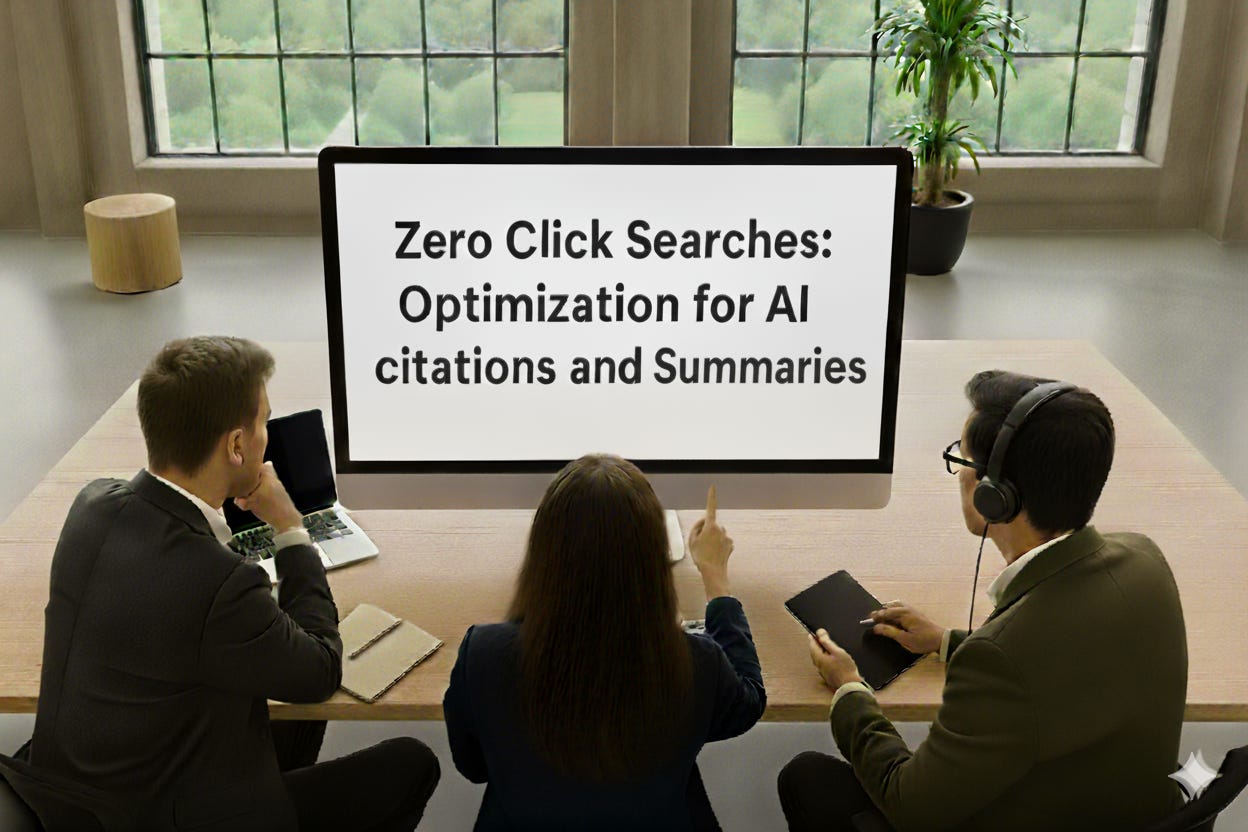
The rise of Zero-Click searches, where AI provides summarized answers directly on the search results page, has transformed how users interact with information online. Instead of clicking through to websites, users increasingly rely on AI-generated responses that cite and summarize trusted sources. For businesses, publishers, and SEO professionals, the question is no longer just “How do I rank on Google?” Instead, the GEO strategy is “How do I become the source AI chooses to cite?”
This Zero-Click shift has accelerated the need for Generative Engine Optimization (GEO), AI credibility strategies, and retrieval-augmented generation (RAG) approaches to ensure visibility (Barrett, 2025k). Let’s dive into the mechanisms shaping this new world of AI search.
📌 What Are Zero-Click Searches?
A zero-click search occurs when users receive information directly within the search interface, without needing to click a blue link. Over the last decade, Google has rolled out features like featured snippets, knowledge panels, and direct answers, but with generative AI, this has become more sophisticated.
Now, large language models (LLMs) synthesize multiple sources using retrieval-augmented generation (RAG) to present nuanced answers (Google Cloud, 2025). Instead of visiting ten different websites, a user might ask an AI assistant one question and get a single summarized response that cites a handful of trustworthy references.
The challenge is obvious: fewer clicks for publishers, but greater concentration of authority for those that are cited.
🔎 From SEO to GEO: The New Frontier
Traditional Search Engine Optimization (SEO) focused on optimizing for Google’s ranking factors like keywords, backlinks, and domain authority. But with AI citation, the game has changed.
Enter Generative Engine Optimization (GEO), a strategy specifically designed to help content surface in AI-driven outputs. GEO is about becoming the cited evidence within generative answers rather than simply ranking high in search (Barrett, 2025f and Barrett, 2025j).
Key GEO strategies include:
Writing with clarity and completeness to align with LLM preference for sufficient context (Joren et al., 2024).
Building the Trust Integrity Score (TIS), a framework for how AI systems evaluate credibility (Barrett, 2025b and Barrett, 2025d).
Testing different content approaches, similar to how A/B testing measures effectiveness across versions (Wikipedia, 2025).
🚀 What Is GEO? Generative Search Optimization for AI Citations
Generative Engine Optimization (GEO) is the emerging SEO evolution focused specifically on optimizing content to be sourced and cited within AI-generated search results rather than simply ranking in traditional blue-link listings. GEO involves shaping content so that the content is not just findable but is trusted and contextually grounded within generative AI responses (Barrett, 2025l).
With AI models synthesizing information from multiple sources to create summaries, the goal of GEO is to position your content as a primary evidence piece that AI platforms prefer when building answers. Unlike classic SEO, which targets ranking factors like backlinks and keywords alone, GEO demands:
Expanding the semantic footprint by covering related concepts and adjacent topics thoroughly.
Fact density and information gain to provide AI with rich, authoritative knowledge.
Transparent citations and structured data that improve machine readability and trust signals.
GEO is not optional but essential in 2025 and beyond, with platforms like Google’s AI Overviews, Bing Copilot, Liner AI, Grok, and Perplexity increasingly prioritizing content optimized for generative search (Barrett, 2025a). This paradigm shift means digital strategies must evolve from chasing high rankings to earning direct AI citations that appear in zero-click responses (Barrett, 2025l).
The transition to GEO also aligns with developments in Trust Integrity Scores (TIS) and retrieval-augmented generation (RAG) systems, which together define how AI selects and ranks sources for AI-synthesized answers (Barrett, 2025l).
By embracing GEO principles, brands and content creators position themselves as foundational authorities for AI-powered search, gaining greater visibility and influence in this new era of zero-click discovery.
Copilot AI Search GEO Citation for Jon Barrett — Prompt Engineering -Video Example Jon A. Barrett September 4, 2025
🏗️ The Role of Trust & Credibility in AI Citations
AI models don’t simply retrieve results; they assess trustworthiness before incorporating a source into a generated summary. Credibility in AI search is judged not just by accuracy, but by transparency, authority, and alignment with established “trustworthiness signals.” (Barrett, 2025c)
This builds on Google’s earlier concept of E-E-A-T (Experience, Expertise, Authoritativeness, Trustworthiness) in SEO and expands SEO into an AI-native system. TIS creates an internal reputation metric among AI engines. Sources with higher trust signals are more likely to be cited, which directly impacts visibility (Barrett, 2025i).
Google stresses that high-quality, original, and context-rich content performs better in AI-driven search experiences (Google, 2025).
🆔 The Role of Digital Object Identifiers (DOIs) in AI Citations
As AI-driven search engines increasingly rely on trustworthy references, Digital Object Identifiers (DOIs) are becoming essential signals of credibility. A DOI is a persistent identifier assigned to digital objects, most commonly academic papers, reports, and research datasets. (Wikipedia, September 2025).
Unlike URLs, which can change over time, DOIs provide a stable and permanent link to the original source. Stability and accessibility make DOI-backed sources an anchor of credibility for both human researchers and AI retrieval systems (Alalaq, 2025).
In the context of AI citations and RAG systems, DOIs play three critical roles:
Authority Signal for AI Engines
When content includes DOI-referenced sources, AI platforms can parse them as higher quality and more enduring references (Joren et al., 2024).
This builds stronger Trust Integrity Scores (TIS) since DOIs often indicate peer-reviewed or curated material (Barrett, 2025d).
Persistence & Long-Term Indexing
AI models performing retrieval rely heavily on content longevity. Broken links (“link rot”) degrade retrieval confidence, whereas DOIs ensure stored knowledge retrieval remains valid, making them highly valued in retrieval-augmented generation (RAG) systems (Google Cloud, 2025).
Enhanced Producer Credibility
Publishers, researchers, or brands citing DOIs demonstrate a commitment to source transparency. Google stresses that platforms rewarding credible sourcing prefer structured, stable references — DOIs provide exactly that. AI platforms prioritize material tied to authoritative, transparent references; DOIs are a gold standard for this. (Google, 2025) and (Barrett, 2025c).
🔧 AI Search Mechanics: Retrieval-Augmented Generation (RAG)
Modern AI search experiences rely on a technique called Retrieval-Augmented Generation (RAG). Instead of generating answers solely from pre-trained data, the AI retrieves external information from indexed sources and integrates the sources into the AI response (Google Cloud, 2025).
Google Research emphasizes the importance of providing sufficient context — information dense enough to fully address user queries without being vague (Google, 2025; Joren et al., 2024). If the content is too shallow, the content may never be selected for retrieval.
This makes depth and clarity crucial. Long-form content that explores a topic comprehensively while remaining understandable is significantly more “AI-friendly” than thin content.
🌍 GEO Optimization Strategies for Winning AI Citations
To succeed in zero-click environments, publishers must adopt GEO as a core pillar of digital visibility. (Barrett, 2025e) outlines a systematic framework:
Structured Formatting — Use clear headers, bullet points, and schema markup to improve machine readability (Barrett, 2025k).
Semantic Richness — Write with topical breadth and depth, ensuring contextual completeness (Joren et al., 2024).
Reputation Building — Build authority through expert citations, industry recognition, and transparent sourcing. (Barrett, 2025h)
AI-Friendly Testing — Experiment with multiple content styles and formats through A/B testing to see which versions surface in AI summaries (Wikipedia, 2025).
Generative Prompt Alignment — Optimize content to align with common prompt phrasing, since AI assistants return different citations based on query style (Google, 2025, Prompt Engineering).
📊 Case Study: From Rankings to Citations
Consider two publishers writing about digital marketing. Publisher A focuses on traditional SEO tactics like backlinks, while Publisher B invests in GEO optimization by adding full-context articles that anticipate AI-driven queries.
Publisher A still ranks in search results but is rarely surfaced in AI summaries.
Publisher B, with AI-optimized content, is cited directly in AI-generated answers, meaning they gain visibility even in zero-click scenarios.
This illustrates the fundamental shift from organic traffic to AI-driven authority positioning.
⚡ The Role of Google’s AI Mode
Google recently introduced AI Mode in search (Google, n.d.), a setting where AI-generated answers with citations are the default. Unlike featured snippets, these responses provide multi-source summaries.
To succeed in AI Mode, Google advises publishers to:
Provide original insights rather than rehashing existing sources.
Include subject-matter expertise and clear sourcing.
Balance readability with sufficient depth.
This confirms that AI citation opportunities are expanding within official search features, not just experimental chatbots (Google, 2025 May 20) and (Google, 2023 February 8).
🚀 From Clicks to Citations: The Future of Visibility
The shift to AI-first search represents the biggest disruption in digital visibility since the rise of Google search rankings themselves. For marketers, visibility no longer means high blue-link placement, but rather being a trusted citation within AI-generated summaries.
GEO optimization determines which voices remain influential in the age of zero-click queries. As AI becomes the “first screen” of information, credibility and contextual completeness will decide winners (Barrett, 2025g and Barrett, 2025h).
📝 Conclusion: Designing Content for AI Citations
Zero-click searches powered by AI make trust, completeness, and context the primary levers of visibility. No longer just about SEO rankings, the future lies in GEO-driven strategies that prepare content for direct citation by AI.
To stand out:
Embrace retrieval-aware writing that frames full, citation-ready insights.
Prioritize the Trust Integrity Score principles to ensure reliability.
Continuously test and adapt content using GEO-focused analytics.
As Google confirms, AI won’t replace high-quality content; AI will amplify the best of the content. The challenge for every publisher is becoming the go-to source AI trusts enough to feature (Google, 2023, and Google, 2025)
The age of AI citation optimization is the future, transforming how content gains authority, trust, and credibility while driving zero-click visibility.
References
A/B Testing. (Updated August 28, 2025, Accessed September 3, 2025). Wikipedia, Wikimedia Foundation, Inc. https://en.wikipedia.org/wiki/A/B_testing
Alalaq, A. S. (August 22, 2025). The Importance of the Digital Object Identifier (DOI) in Enhancing the Credibility of Scientific Research: An Analytical Data Study. arXiv preprint arXiv:2508.20118. https://arxiv.org/abs/2508.20118, https://doi.org/10.48550/arXiv.2508.20118
Barrett, J. (August, 2025a). How to Get Cited on AI Platforms: Earning Trust in Generative Search. Medium.
Barrett, J. (August, 2025b). Trust Integrity Score vs. Google E-E-A-T: AI Platform Credibility. Medium.
Barrett, J. (August, 2025c). What Defines an AI Platform Citation as Trustworthy and Credible. Medium.
Barrett, J. (August, 2025d). What is the Trust Integrity Score: AI Citation Credibility and Trust. Medium.
Barrett, J. (August, 2025e). GEO AI Citation Strategy: How to Earn Citations by AI Platforms. Medium.
Barrett, J. (August, 2025f). SEO vs. GEO: The Strategy for Securing Prompt Results on AI Platforms. Medium.
Barrett, J. (August, 2025g). How to Get Cited in AI Search Results: Build Trust and Credibility. Medium.
Barrett, J. (August, 2025h). How to Rank in AI Citations: Strategies for Generative Search GEO. Medium.
Barrett, J. (September, 2025i). How to Rank in AI Search: Trust and AI Citation Strategies. Medium.
Barrett, J. (September, 2025j). From SEO Ranking to AI Citation: The Shift to GEO Strategy. Medium.
Barrett, J. (September, 2025k). Get Cited by AI: Your Guide to Generative Search Optimization (GEO). Medium.
Barrett, J. (September, 2025l). What is GEO? Generative Search Optimization for AI Citations. Medium.
Digital object identifier. (Updated September 3, 2025, Accessed September 3, 2025). Wikipedia, Wikimedia Foundation, Inc. https://en.wikipedia.org/wiki/Digital_object_identifier
Google. (2023, February 8). Google Search and AI-generated content. Google Search Central Blog. https://developers.google.com/search/blog/2023/02/google-search-and-ai-content
Google. (2025, May 14). Deeper insights into retrieval augmented generation: The role of sufficient context. Google Research Blog. https://research.google/blog/deeper-insights-into-retrieval-augmented-generation-the-role-of-sufficient-context/
Google. (2025, May 20). Top ways to ensure your content performs well in Google’s AI experiences on Search. Google Search Central Blog. https://developers.google.com/search/blog/2025/05/succeeding-in-ai-search
Google Cloud. (2025, May 20). What is Retrieval-Augmented Generation (RAG)? https://cloud.google.com/use-cases/retrieval-augmented-generation
Google. (2025, August 25). Prompt Engineering for Generative AI. Developers Resource. Last updated 2025–08–25 UTC, Accessed September 3, 2025. https://developers.google.com/machine-learning/resources/prompt-eng
Google. (n.d.). AI Mode. Accessed September 3, 2025. https://search.google/ways-to-search/ai-mode/
Joren, H., Zhang, J., Ferng, C. S., Juan, D. C., Taly, A., & Rashtchian, C. (2024). Sufficient context: A new lens on retrieval augmented generation systems. arXiv preprint arXiv:2411.06037.
https://doi.org/10.48550/arXiv.2411.06037
About the Author:
Jon Barrett is a Google Scholar Author, a Google Certified Digital Marketer, and a technical content writer with over a decade of experience in SEO content copywriting, GEO Cited content, technical content writing, and digital marketing. He holds a Bachelor of Science degree from Temple University, along with MicroBachelors academic credentials in both Marketing and Academic and Professional Writing (Thomas Edison State University, 2025). He has written multiple cited, authored, and co-authored scientific and technical content and published articles.
His professional technical writing covers process safety engineering, industrial hygiene, real estate, construction, and property insurance hazards and has been referenced in the AIChE — American Institute of Chemical Engineers, July 2025 issue, of the Chemical Engineering Progress Journal: https://aiche.onlinelibrary.wiley.com/doi/10.1002/prs.70006, the Journal of Loss Prevention in the Process Industries, Industrial Safety & Hygiene News, the American Society of Safety Professionals, EHS Daily Advisor, Pest Control Technology, and Facilities Management Advisor.
Google Scholar Author: https://scholar.google.com/cit...
LinkedIn Profile: https://www.linkedin.com/in/jo...
Personal Website: https://barrettrestore.wixsite.com/jonwebsite
Google Certified, SEO and GEO AI Cited, Digital Marketer
(This Article is also published on Medium, Twitter, and Muck Rack where readers are already learning the strategy!)
Intellectual Property Notice:
This submission and all accompanying materials, including the article, images, content, and cited research, are the original intellectual property of the author, Jon Barrett. These materials, images, and content are submitted exclusively by Jon Barrett. They are not authorized for publication, distribution, or derivative use without written permission from the author. ©Copyright 2025. All rights remain fully reserved.